


Upgrade Your ERP One Module at a Time: The Composable ERP Playbook
This article argues that a composable ERP upgrade strategy allows organizations to modernize incrementally—extending and evolving their ERP landscape with best-of-breed solutions—so they can reduce risk, avoid disruptive “big bang” replacements, and deliver value on their own timeline rather than the vendor’s.

For decades, ERP modernization has been thought of as an all-or-nothing proposition. The monolithic nature of traditional ERP systems has forced organizations to take the good with the bad, investing enormous amounts of time, money, and organizational energy to overhaul an entire platform when, strategically, they might only need to improve on a handful of business capabilities.
To put this into perspective, consider a manufacturer that runs a tight operation on the finance and sales side. Revenue is recognized correctly, orders are flowing, and the team knows the system inside and out. But, on the supply chain side of the house, it's a different story. We’re talking about the kinds of issues that stand in the way of agility: limited visibility, manual workarounds, and operational blind spots. Under the traditional ERP model, fixing that means touching everything. A targeted upgrade simply isn't on the table.
Today’s businesses need a more flexible path. They need the ability to gain access to new functionality, modernize workflows, improve user experiences, unlock data, and introduce AI capabilities without constantly destabilizing the operational systems that keep the business running. That shift is giving rise to a new way of thinking about enterprise architecture: composable ERP.
In this article, we’ll explore what composable ERP actually means, why traditional big-bang ERP projects often struggle, and how smart organizations are taking a more incremental approach by modernizing one capability at a time. We’ll also look at the growing role of the data layer, modular innovation, and why this architectural shift matters more than ever in the age of AI.
What is Composable ERP?
While the term “Composable ERP” was popularized by Gartner in recent years, the underlying idea has been evolving for decades. In many ways, the conversation traces all the way back to 1972, when SAP revolutionized enterprise computing with their introduction of an integrated, real-time business software platform. At the time, this concept was groundbreaking. Rather than managing separate islands of information across finance, manufacturing, procurement, and operations, organizations could finally centralize critical business processes inside a unified system.
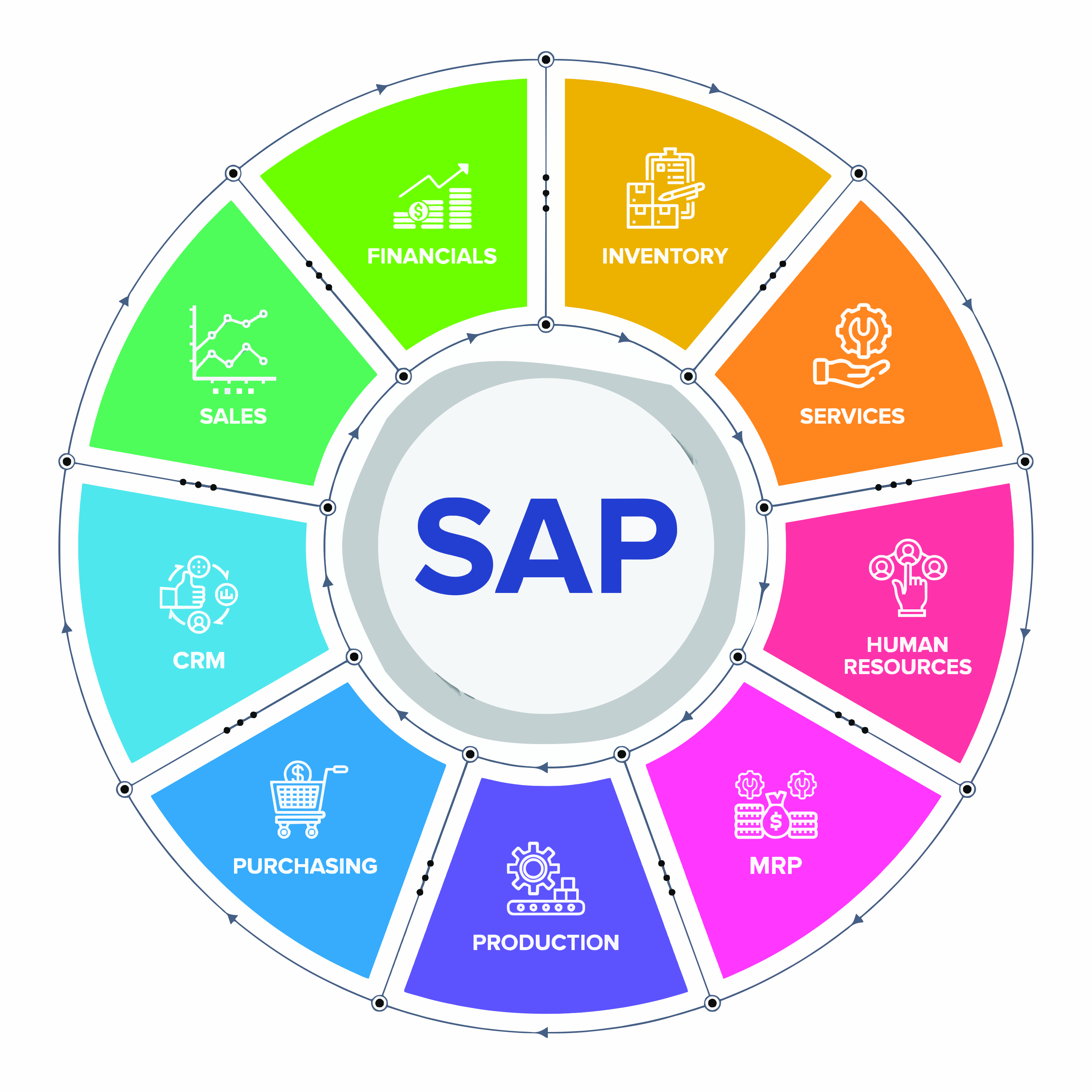
Figure 1: SAP's Modular ERP Design Concept
Back then, a monolithic ERP architecture built on top of a central database made a ton of sense. Networking technology was limited, integration standards were immature or nonexistent, and connecting software systems together was both technically difficult and operationally risky. The idea of building a “best-of-breeds” environment by stitching together multiple software packages often resulted in fragile integrations, duplicated data, inconsistent reporting, and expensive custom development projects. For most organizations, the safest and most practical approach was to standardize on a single vendor platform whenever possible.
There was also a significant user experience consideration. Running multiple business applications typically meant forcing employees to navigate several disconnected user interfaces, workflows, and authentication systems. The learning curve was often steep, especially for organizations already struggling with ERP adoption and change management.
Fast forward to today, and many of the barriers that once made those best-of-breeds strategies undesirable have mostly disappeared. Cloud computing, high-speed networking, REST APIs, integration platforms, identity providers, and modern data technologies have dramatically simplified the process of connecting systems together. At the same time, SaaS vendors have introduced highly specialized applications capable of delivering richer functionality and faster innovation cycles than traditional monolithic ERP platforms can often provide on their own.
At its core, composable ERP is essentially a modern evolution of the best-of-breeds concept. Rather than relying on a single monolithic platform to handle every business capability, organizations now have the option to compose their ERP ecosystem by weaving together smaller, more modular applications and services, many of which are delivered as SaaS solutions. The core ERP platform remains critically important, but it's now part of a broader digital ecosystem rather than the center of every user interaction and business process.
Beyond Best of Breeds
Importantly, composable ERP is about far more than software procurement strategy. When done correctly, it creates the architectural foundation needed to take your ERP investment(s) to the next level. These foundational elements provide the agility needed to simplify user experiences, fill in functional gaps, streamline end-to-end process flows across systems, and consolidate reporting and analytics into a more cohesive operational picture.
As you can see in Figure 2 below, composable ERP architectures are built on a modular foundation that helps weave ERP modules, SaaS applications, workflows, data platforms, and user experiences together into one unified business environment. Modern cloud platforms like Microsoft Azure, Amazon Web Services (AWS), and Google Cloud Platform (GCP) have accelerated this shift by making it much easier to connect systems, automate processes, unify data, and scale over time. Instead of spending years building custom infrastructure from scratch, it's now possible to gain traction in these areas in a matter of weeks.

Figure 2: The Slow Evolution Towards Composable ERP
The Age of the ERP Monolith is Over
For the past few years, ERP software vendors have pushed a carefully crafted narrative around the dangers of composable ERP and best-of-breeds architectures. Customers have been warned about integration complexity, fragmented user experiences, inconsistent data, security concerns, and runaway support costs. The message has been clear: stay inside the nurturing biosphere of the flagship ERP suite or risk introducing crippling complexity into the business.
There’s just one problem with that narrative.
The dirty little secret of the modern ERP market is that it’s already best-of-breeds.
Over the past two decades, leading enterprise software vendors like SAP and Oracle have gone on massive acquisition sprees, purchasing SaaS products and cloud platforms across nearly every major business category imaginable. Human capital management, procurement, analytics, CRM, supply chain planning, commerce, customer experience, integration, and AI platforms have all been folded into broader enterprise portfolios through acquisition after acquisition. In many cases, these products were originally built as entirely separate platforms with their own architectures, data models, workflows, and user experiences.
In other words, the very vendors warning customers about the risks of composable ERP have spent years building composable ERP platforms themselves.

Figure 3: The Hypocrisy of Legacy ERP Software Vendors
The difference is that today’s “single vendor ERP suite” is often less of a monolithic application and more of a loosely connected ecosystem of acquired cloud services operating under a shared brand umbrella. Behind the marketing language, many enterprise software portfolios are already stitched together using APIs, integration layers, identity platforms, shared analytics services, and cross-application workflows. The architecture has changed, even if the messaging has not.
That shift reflects a broader reality in enterprise software: no single platform can realistically innovate across every business domain at the same pace as a specialized ecosystem of focused products and services. The market has already moved toward modularity. Composable ERP simply acknowledges it openly and gives customers the architectural flexibility to make those decisions intentionally rather than being locked into a single vendor’s acquisition roadmap.
Why Big-Bang ERP Rollout Projects Struggle
ERP rollout projects are normally built around a simple premise: replace or upgrade everything at once, standardize organizational business processes around the new platform, and cross the finish line in one massive initiative. On paper, this approach sounds logical. In practice, however, these projects frequently become some of the most expensive, disruptive, and difficult transformations an organization will ever attempt.
The first problem is scale. ERP systems have tentacles into everything: finance, procurement, supply chain, manufacturing, HR, customer operations, reporting, compliance, and countless day-to-day workflows. Trying to redesign all that at once generates a ton of organizational complexity. Every department has competing priorities. Every workflow has edge cases. And every customization carries years of business context that someone has to untangle.

Figure 4: ERP Implementation Teams Trying to Untangle Years' Worth of Customizations
Frozen in Time
Large ERP rollouts often take years to complete, particularly in organizations with multiple business units, international operations, or deeply customized legacy environments. These multi-year projects create huge innovation bottlenecks for business teams that can't afford to stand still for 3-5 years while the transformation program runs its course. During that time, markets shift, leadership changes, and disruptive technologies like AI emerge. By the time the ERP project goes live, it's possible that parts of the original roadmap are already starting to show their age.
The Realities of Change Fatigue
Change fatigue is a real thing. Big-bang ERP projects ask organizational teams to absorb massive disruption all at once. Employees are expected to learn new systems, adapt to redesigned workflows, migrate historical data, and maintain business continuity simultaneously. Even well-run projects generate friction when users feel like familiar processes are being dismantled faster than meaningful value is being delivered.
The All-or-Nothing Trap
Ironically, many organizations pursuing large-scale ERP transformations aren't trying to reinvent every aspect of the business. Instead, they may be trying to address a smaller set of common problems:
- Limited visibility to key processes
- Spreadsheet-driven workarounds
- Disconnected workflows
- Reporting bottlenecks
- Operational blind spots that quietly erode agility over time
Embarking on an ERP upgrade project to fix problems like this is the enterprise equivalent of burning down the house to fix a leaky faucet. However, because traditional ERP architectures are so tightly coupled, companies often feel forced into huge upgrade projects just to modernize a handful of critical capabilities.
That tension is even sharper in the age of cloud and AI. Businesses today are under constant pressure to move faster, experiment more freely, and continuously improve digital experiences. Large, multi-year ERP projects struggle to keep pace with that speed. While transformation teams are still working through rollout phases and migration timelines, business users are already adopting SaaS tools, building workflows in low-code platforms, and finding their own ways to work around friction in the system.
None of this means ERP modernization is the wrong goal. The challenge is that the traditional "replace everything at once" model no longer fits how modern businesses actually evolve. Organizations need the ability to modernize incrementally, introduce new capabilities selectively, and adapt their operational landscape over time without repeatedly putting the systems that run the business at risk.
Eating the ERP Elephant One Bite at a Time
One of the biggest advantages of a composable ERP strategy is that it enables you to modernize at a pace that feels operationally and financially manageable. Instead of attempting to replace or redesign the entire ERP landscape all at once, you can instead focus on improving specific capabilities, workflows, or user experiences incrementally over time.
In many cases, the ERP system itself is not the problem.
The real friction often exists at the edges of the business, where employees interact with customers, manage operational workflows, analyze information, or coordinate work across teams. These are the areas where expectations around usability, mobility, automation, and responsiveness have changed dramatically over the past decade.
Case Study: Extending the Reach of the ERP Core
To put these concepts into perspective, consider an energy company managing field service and maintenance operations. Here, the core ERP platform may already be doing exactly what it was designed to do: managing inventory, tracking equipment, processing work orders, settling costs, handling procurement, and managing time and expense reporting. From a transactional standpoint, the system may be functioning perfectly well.
Meanwhile, the frontline experience is a vastly different story.
Field technicians often need mobile-friendly tools that work reliably from trucks, substations, remote facilities, or customer locations. They need streamlined service request management, simplified inspection workflows, photo capture, digital forms, offline capabilities, GIS integration, real-time collaboration, and faster access to operational data. Trying to force those modern field experiences directly into a traditional ERP interface can quickly become cumbersome, expensive, and difficult to evolve.
A composable ERP approach empowers companies like this to modernize that specific capability without destabilizing the rest of the operational core. Instead of replacing the entire ERP platform, the company might introduce a modern field service application, mobile workflow solution, or custom frontline experience that integrates with the ERP behind the scenes. The ERP continues handling the transactional backbone of the business, while newer applications improve usability, workflow orchestration, and operational agility closer to where the work actually happens.

Figure 5: Streamlining Work Order Scheduling with Dynamics 365 Field Service
This approach dramatically changes the nature of ERP modernization projects. Rather than placing a massive, multi-year bet on a single transformation initiative, organizations can deliver targeted improvements in areas where the business will feel the impact most quickly. Projects become smaller, faster, easier to govern, and easier to justify from an ROI perspective. Teams can learn and adapt as they go instead of trying to predict every future requirement upfront.
Over time, those smaller modernization efforts begin to compound. One improved workflow leads to another. A mobile field experience connects to a modern data platform. Workflow automation reduces manual handoffs. Analytics become more real-time. AI capabilities begin surfacing operational insights across systems. Little by little, the business evolves into a far more agile and intelligent operational environment without requiring the organization to rip out the systems that already work well today.
Plant Your Flag in the Data Layer
If composable ERP is the architectural strategy, the data layer is the foundation that makes it possible.
One of the smartest places to begin a modernization journey is not inside the ERP application itself, but underneath it. Modern data platforms like Microsoft Fabric create a centralized foundation where operational data from ERP systems, SaaS applications, spreadsheets, IoT platforms, customer systems, and other business applications can be brought together in one place. In many ways, the data platform becomes a beachhead for broader ERP modernization efforts while simultaneously laying the groundwork for future innovation across the business.
This matters because most of the operational pain points organizations struggle with today are not purely transactional problems. They tend to fall into a few familiar categories:
- Visibility Problems: The business can't see what's happening across systems in real time.
- Integration Problems: Data lives in silos that were never designed to talk to each other.
- Workflow Coordination Problems: Processes span multiple systems with no clean handoffs between them.
- Decision-Making Problems: Leaders are working from incomplete or outdated information.
Businesses often have the data they need, but it's scattered across dozens of systems with no cohesive way to unify, operationalize, and act on it in real time.
A modern data fabric addresses that by creating a shared intelligence layer across the organization. Instead of forcing every integration, report, workflow, and AI initiative to connect directly into the ERP, the data platform becomes an intermediary that simplifies access to trusted business information. Reporting becomes easier to standardize. Analytics become easier to share across departments. SaaS applications become easier to integrate. Automation services gain access to cleaner, more reliable business context.

Figure 6: Building a Data Control Plane Using Microsoft Fabric as a Foundation
This is especially valuable in composable ERP environments where organizations may be running a mix of legacy ERP platforms, cloud applications, mobile solutions, and industry-specific systems. Without a strong data foundation, modular architectures can quickly devolve into disconnected islands of information. A data fabric prevents that fragmentation by creating consistency across the broader ecosystem.
The impact on AI is equally significant. Most organizations are eager to adopt copilots, intelligent automation, AI agents, and predictive analytics, but quickly discover that fragmented data is the first thing standing in the way. AI thrives on accessible, well-organized, cross-functional business context. Therefore, when operational data is unified inside a modern data platform, organizations can move much faster in building AI-powered workflows, automation, and operational intelligence that span multiple systems at once.
Just as importantly, establishing the data layer early enables you to start moving without waiting for a massive ERP replacement to unlock progress. Analytics, automation, reporting, and digital experiences can all improve immediately, while operational systems evolve gradually over time. The data platform becomes the connective tissue that supports today's ERP landscape and tomorrow's composable architecture at the same time.
Innovation at the Edges
One of the most important architectural shifts behind composable ERP is the growing emphasis on clean core design principles. Rather than heavily customizing the (extended) ERP platform, organizations are increasingly moving innovation activities outside the transactional core and into surrounding application, workflow, integration, and data layers.
That distinction matters more than ever.
Historically, ERP environments evolved through years of customization built directly inside the platform. Custom code, modified workflows, embedded business logic, and tightly coupled integrations became deeply intertwined with the core over time. Those customizations often solved real business problems, but they introduced a compounding tax on every future upgrade. Before moving forward, organizations first had to untangle years of accumulated modifications, making every upgrade riskier, more expensive, and more time consuming than it needed to be.
Composable ERP changes that equation.
Modern integration services, low-code platforms, API layers, and cloud-native development tools make it far easier to build extensions that live alongside the ERP rather than inside it. When the business needs a new workflow, mobile experience, approval process, customer portal, or AI-powered capability, organizations can build it externally and integrate it back into the broader ecosystem securely. The core stays clean while customizations remain manageable. And, importantly, upgrades become much more straightforward.

Figure 7: The Side-by-Side Extensibility Concept
This "innovation at the edges" model enables you to modernize aggressively without destabilizing the systems that run your core operations. Teams can experiment with new user experiences, automate workflows, extend business processes, and introduce modern digital capabilities while the ERP continues doing what it does best: managing transactions, enforcing operational controls, and maintaining system-of-record integrity.
In practice, that might look like:
- A modern supplier collaboration portal
- A mobile field service application
- AI-assisted maintenance workflows
- Automated approval processes inside Microsoft Teams
- Customer self-service experiences
- Real-time operational dashboards
- Intelligent document processing solutions
None of these require direct modification of the ERP core. Each can be developed as a loosely coupled extension, connected back into the broader ecosystem through APIs, integration services, workflows, and shared data platforms.
The long-term payoff is significant. By keeping customization out of the core, organizations dramatically simplify every future upgrade. ERP updates stop being about re-engineering years of embedded custom logic and start being about validating integrations around a stable operational foundation. The platform becomes easier to maintain, easier to evolve, and far less likely to become a bottleneck for innovation.
That is the real promise of composable ERP. Not simply buying modules from different vendors, but building an architecture that allows the business to continuously evolve around a stable core without turning every innovation initiative into a high-risk modification project.
Why Composable ERP Matters in the Age of AI
ERP systems were built to be systems of record: capturing transactions, enforcing process controls, and maintaining operational consistency. Those capabilities remain essential. But AI is introducing a new expectation on top of them. Businesses now want software that helps employees make faster decisions, automates repetitive work, surfaces insights proactively, and coordinates actions across systems in real time.
That shift plays directly into the strengths of composable ERP.
AI thrives where data, workflows, APIs, and business context are accessible across the organization. Traditional monolithic ERP environments were not built with that kind of openness in mind. Data silos, tightly coupled customizations, and brittle integration layers make even relatively simple automation initiatives difficult to orchestrate. Composable architectures remove many of those barriers by design. Modular applications, shared data platforms, API-driven integration, and loosely coupled business capabilities create a natural foundation for AI-powered automation and intelligent business experiences.
This matters because the future of enterprise AI will not live inside ERP screens.
Work happens across collaboration platforms, mobile applications, customer portals, dashboards, and industry-specific tools. AI agents need access to information spanning all of those environments at once. A field technician's AI assistant might need to combine equipment history from the ERP, maintenance procedures from SharePoint, live telemetry from IoT sensors, inventory availability from supply chain systems, and scheduling data from a field service platform simultaneously. That kind of cross-functional orchestration is far more achievable when the business is built on composable principles.
The same applies to automation more broadly. AI-powered workflows that summarize operational events, route approvals, predict issues, generate work orders, and coordinate actions between systems don't work well when data and processes are trapped inside isolated application silos. Composable ERP helps break down those silos before they become a ceiling on what AI can actually do.
There's also a speed advantage worth noting. AI capabilities are evolving too quickly for organizations to wait through multi-year ERP transformation programs before experimenting. Composable architectures allow businesses to adopt new AI capabilities incrementally, connect emerging technologies rapidly, and evolve workflows continuously without touching the ERP core.
The organizations that move fastest with AI will not necessarily be the ones with the largest platforms. They will be the ones with the most flexible architectures, the cleanest data foundations, and the ability to compose new capabilities around the edges of the business as technology continues to evolve.
Closing Thoughts
The future of ERP modernization is unlikely to be defined by massive rip-and-replace projects. The smarter path is incremental, modular, and business-driven. Rather than routing every innovation initiative through the ERP core, composable ERP lets organizations modernize selectively, improve experiences where it matters most, and evolve operational capabilities continuously over time.
Most importantly, it gives organizations flexibility. Flexibility to adopt new technologies faster. Flexibility to integrate specialized solutions where they add the most value. Flexibility to unify data, simplify workflows, and introduce AI-powered automation without repeatedly putting mission-critical systems at risk.
The irony is that composable ERP is not about abandoning ERP. It's about putting it in its proper place: a stable operational backbone surrounded by modern data platforms, intelligent workflows, modular applications, and connected digital experiences. The organizations that embrace that model will be far better positioned to adapt, scale, and compete as the pace of change continues to accelerate.