
Customer Portals
Self-service experiences where your customers can access their accounts, track orders, find answers, and get support without having to pick up the phone.
Self-Service Portals
Give your customers, suppliers, and partners a self-service portal that answers their questions, handles routine requests, and triages the rest, so your team can focus on the issues that really need them. Backed by real-time connections to the systems that run your business, it’s a living front door, not static pages someone has to process later.
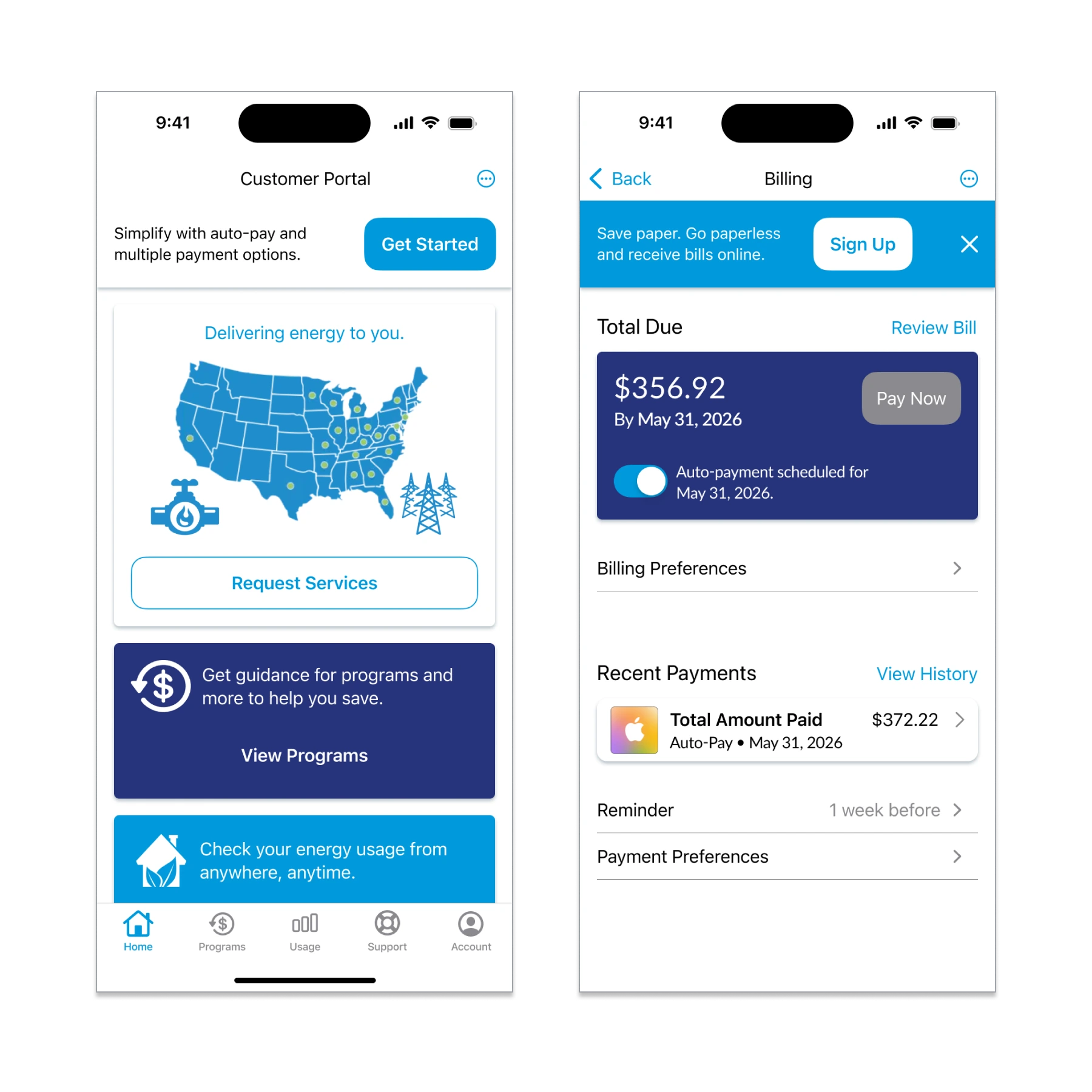
A portal is a secure, self-service gateway for the people outside your walls — your customers, suppliers, partners, and employees — to interact with your business directly. Instead of calling, emailing, or waiting on someone internally, they can log in and get what they need right away: checking on an order, submitting an invoice, updating their information, or finding an answer on their own.
Of course, the front-end is the easy part. Anyone can build a login screen and a few nice-looking pages. The real value, and the hard part, is what happens behind it. Our deep enterprise integration roots mean we connect portals directly and securely to your backend systems, so the information people see is live and the transactions they complete are real. An order status reflects your actual ERP. A submitted invoice lands in your finance system. Nothing waits in a queue for someone to re-key it.
That same foundation lets us take self-service a step further with AI-powered agents built right into the portal experience. Instead of hunting through menus, users can simply ask, in plain language, and get answers, complete routine requests, and resolve common Level 1 issues on their own. When something genuinely needs a person, the agent triages it and hands it off to your team with the context already attached. And because the agent is grounded in your connected systems, it gives real, account-specific answers, not the generic, canned responses of a bolt-on chatbot.
That depth is what turns a portal from a brochure into a tool. It removes the manual handoffs and back-and-forth that live between organizations, cuts down the calls and emails your team fields all day, and gives everyone, on both sides of the relationship, a faster and better experience.
Self-service experiences where your customers can access their accounts, track orders, find answers, and get support without having to pick up the phone.
Secure gateways that streamline procurement, onboarding, and invoicing, replacing email chains and manual paperwork with direct, structured interactions.
Branded portals that give partners, dealers, and resellers the information, tools, and visibility they need to do business with you efficiently.
Internal and membership portals that put resources, requests, and records in one secure place, reducing the load on your team.
“Our support team spends all day answering the same questions customers could answer themselves.”
 VP of Customer Service
“Supplier onboarding is a mess of emails, spreadsheets, and PDFs that someone has to chase down.”
 Director of Procurement
“Our partners keep calling for order status because they have no way to see it themselves.”
VP of Channel Sales
“We have a portal, but it’s just static pages. It can’t actually show real data or process anything.”
 Director of IT
“Everything a customer submits has to be manually re-entered into our back-end systems.”
 Operations Manager
We start with integration, not the interface. Before we design a single screen, we map how the portal needs to connect to your ERP, CRM, and other systems, because that connection is what makes a portal genuinely useful. Getting it right means the data is always current and the transactions are always real, with no manual layer in between.
Security comes with the territory. A portal opens part of your business to people outside it, so authentication, authorization, and data protection are designed in from the start. Every user sees exactly what they should, and nothing they shouldn’t, whether they’re a customer, a supplier, or a partner.
On top of that foundation, we build a modern, commercial-grade experience. Our team designs portals that are clean, intuitive, and genuinely pleasant to use, because adoption depends on it.
Map how customers, suppliers, or employees interact with your business and systems today.
Create a clean, intuitive experience that's easy for your partners to use.
Launch a solution your customers, suppliers, and partners actually pick up and use from day one.
Still have questions? We'd rather answer them in a conversation than bury them in a brochure.
Talk To Our TeamThis article explores how Microsoft Copilot Studio helps organizations move beyond personal AI productivity by turning successful AI experiments into secure, governed, and reusable enterprise agents.
This article explores why large language models often struggle to generate reliable business insights from raw enterprise data and examines the emerging intelligence layers that vendors like Microsoft and SAP are building to provide AI with richer business context.
This article recaps Bowdark’s top blog themes and insights from 2025, highlighting how ideas around AI, data, composable ERP, and modern development converged into a consistent focus on turning complex technology into practical, real-world value.
Ready When You Are
Whether you’re replacing a portal that never lived up to its promise or building one for the first time, tell us who you’re trying to serve and what’s getting in the way today. We’ll help you figure out the right path forward.