



When ERP Starts to Think: The Evolution from ERP to ERX
This article explores the evolution from traditional ERP to Enterprise Resource Execution (ERX), how AI is enabling more autonomous business operations, and why organizations don't have to replace their existing ERP systems to start taking advantage of these capabilities.

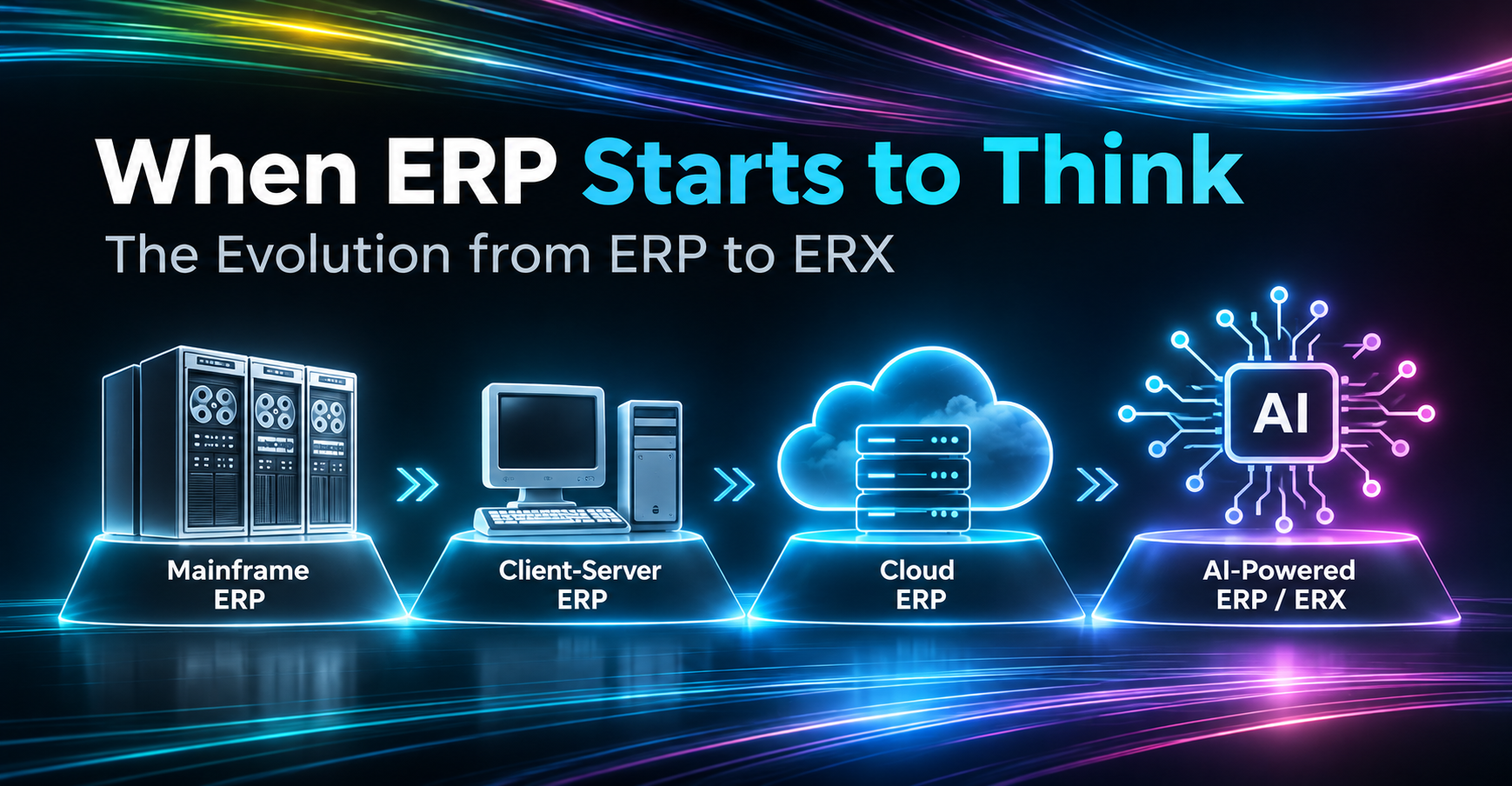
ERP systems have always been pretty good at following instructions. Give them a set of business rules, configure the appropriate workflows, and they'll reliably process transactions all day long. But ask them to figure out what to do when something unexpected happens, and that's where things start to unravel.
Advances in AI are beginning to change that dynamic. Gartner has recently introduced the term Enterprise Resource Execution (ERX) to describe a future where ERP systems move beyond processing transactions and supporting decisions to actively participating in the execution of business processes.
In this article, we'll explore how ERP has evolved toward this vision, what makes ERX different, and how organizations can begin taking advantage of these capabilities without necessarily replacing their existing ERP systems. We'll also consider what happens when we start giving enterprise software more freedom to make decisions and take action on our behalf.
What Happens After the Transaction?
Consider a customer order that's at risk of missing its promised delivery date. Your ERP system has all the relevant information there at the ready: inventory levels, production schedules, outstanding purchase orders, and shipping commitments. Depending on how it's configured, it might even recognize the potential delay and raise an alert.
But what happens next? Someone has to investigate the situation, determine what's causing the delay, evaluate potential alternatives, and decide how to proceed. That might involve checking with suppliers, adjusting production schedules, coordinating with logistics providers, or communicating with the customer. Much of that work happens outside the ERP system, even though the information needed to make those decisions may already exist somewhere within the enterprise.
Moving Beyond IF…THEN…ELSE
Most of the “decision-making” we’ve seen in ERP over the years has really been rules somebody wrote down ahead of time for a workflow or business rules engine to follow. These capabilities introduced a degree of intelligence into what were otherwise largely static systems, but they came with some significant limitations.
Traditional workflow and rules engines generally relied on predefined conditional logic (IF...THEN...ELSE), decision tables, and decision trees. Developers had to anticipate each and every scenario a business might encounter and explicitly define how the system should respond. The more complex and unpredictable the process, the harder it became to account for every possibility.
The advanced reasoning capabilities of large language models (LLMs) have fundamentally changed that equation. Consider the agentic workflows we can now build using tools like Microsoft Copilot Studio. In the customer service workflow depicted in Figure 1, frontier AI models from providers like Anthropic and OpenAI serve as the brains of the operation, analyzing complex customer feedback to understand its context, determine the nature of the issue, and decide what should happen next.

Figure 1: Applying Complex Reasoning to a Customer Service Workflow
Based on that reasoning, the workflow can route feedback to the appropriate team, create service tickets, or initiate other actions across connected business systems. Rather than requiring developers to anticipate every possible variation in customer feedback and explicitly program how to handle it, these models bring generalized reasoning capabilities that allow workflows to adapt to a much broader range of situations.
The basic ingredients in these next-generation workflow processes are relatively straightforward. We provide the agent with context about the business event that triggered the workflow, access to knowledge sources it can consult for additional information, and tools it can use to interact with backend business systems. We then use natural language instructions to explain the agent's purpose, what resources it has available, and how it should approach its work. Combined with appropriate permissions, business rules, and other guardrails, this allows us to build workflows that can reason through situations and determine which actions to take without having to explicitly program every possible scenario.
From Systems of Record to Systems of Execution
Think about how the expectations we've placed on ERP systems have changed over the years. Initially, we wanted them to reliably capture transactions and maintain consistent records across the business. Then we wanted better reporting, more sophisticated analytics, and greater automation. More recently, we've started asking these systems to help us anticipate problems and make better decisions. Now, with ERX, we're beginning to ask them to take action on those decisions as well.
Gartner describes this progression through five stages of ERP evolution, as illustrated in Figure 2. The first three stages (Ad Hoc ERP, Foundational ERP, and Scalable ERP) focus primarily on establishing ERP as a trusted operational foundation, improving process visibility, scalability, and alignment with business strategy. The final two stages (Intelligent ERX and Autonomous ERX) represent a more significant shift, where AI begins taking a central role in how business processes are managed and executed.

Figure 2: The Five Stages of ERP Evolution (Source: Gartner)
What's particularly interesting about this progression is how the relationship between people and enterprise software begins to change. Historically, most advances in ERP have focused on helping people run the business more effectively. We've integrated more functions, improved access to information, automated predictable processes, and introduced increasingly sophisticated decision support. But people have largely remained responsible for interpreting what's happening and deciding what to do next.
With Intelligent ERX, agentic AI begins taking on more of that responsibility, helping organizations move from periodic, human-driven decisions toward more continuous, real-time execution. Autonomous ERX takes that vision further, with AI agents capable of coordinating and executing business processes with greater independence, operating within established business policies and controls.
It's a significant departure from the traditional role of ERP as a system of record. Rather than primarily capturing what's already happened, ERX introduces the possibility of enterprise systems that can anticipate what's coming, respond to changing conditions, and actively participate in running the business.
The Anatomy of Autonomous ERP
So, what does an ERP system that's capable of thinking and acting on its own actually look like? According to Gartner, the differences between traditional ERP and ERX extend well beyond the addition of AI agents or more sophisticated automation.
As illustrated in Figure 3, Gartner describes this transformation across four dimensions: the nature of the system, its function, its underlying structure, and the pace at which it operates.

Figure 3: Traditional ERP vs. Enterprise Resource Execution (Adapted from Gartner)
Traditional ERP systems have primarily served as systems of record, capturing transactions, enforcing business rules, and maintaining a historical account of business activity. ERX introduces the concept of a system of continuous execution, where enterprise software can monitor changing conditions and coordinate actions as events unfold.
The underlying architecture changes as well. Rather than relying on a single, tightly integrated application suite to manage every process, ERX envisions a more composable environment where AI agents, data platforms, and business applications work together through event-driven integration and orchestration. This allows intelligent capabilities to operate across traditional application boundaries.
Perhaps the most significant difference is the pace of execution. Traditional ERP processes frequently depend on scheduled jobs, periodic planning cycles, and human intervention to move work forward. ERX moves toward continuous, event-driven operations where AI agents can respond to changing business conditions without waiting for someone to initiate the next step.
What Makes ERX Possible?
Gartner identifies six characteristics that help define this emerging generation of enterprise software:
- Adaptive Experience: User interfaces that adjust to the needs, context, and responsibilities of individual users, including conversational experiences that reduce reliance on traditional application screens.
- Embedded Insights: Analytics and intelligence incorporated directly into business processes, allowing systems to identify emerging conditions and support decisions as work happens.
- Fluid Knowledge: Business knowledge that can be accessed and applied across applications, documents, and data sources rather than remaining confined to individual systems.
- Autonomous Orchestration: AI agents that can coordinate activities, make decisions, and execute business processes across multiple systems within established policies and controls.
- Connected Data: Integrated access to operational and analytical data, giving agents the context they need to understand what's happening across the business.
- Composable Architecture: Modular services, APIs, and applications that can be assembled and adapted without depending entirely on a single monolithic ERP platform.
Individually, many of these capabilities have been available in some form for years. We've been building APIs, integrating data, embedding analytics, and creating more flexible user experiences for a long time. What's different now is the emergence of AI models capable of reasoning across those capabilities and coordinating them toward a business objective.
That combination is what makes the ERX vision particularly interesting. The intelligence doesn't necessarily have to reside within the ERP application itself. It can operate across the broader enterprise technology landscape, using existing systems as sources of information and tools for executing business processes.
Thinking Outside the ERP Box
One of the more interesting aspects of Gartner's ERX vision is that you don't necessarily have to wait for your ERP vendor to deliver it. While enterprise software vendors like SAP, Microsoft, and Oracle are investing heavily in bringing AI capabilities into their enterprise applications, the broader vision for ERX extends well beyond the boundaries of any individual system.
Consider Gartner's conceptual ERX architecture, illustrated in Figure 4. Rather than depicting ERP as the center of everything, the architecture brings together several layers of capabilities, including adaptive user experiences, AI agents, orchestration services, and modern data platforms. Traditional enterprise applications remain an important part of the picture, but they're increasingly surrounded by intelligent services that can operate across application boundaries.

Figure 4: Conceptual ERX Architecture (Source: Gartner)
If that architecture looks familiar, there's a good reason. This design builds on the composable ERP playbook that forward-thinking enterprises have been running for years. The big difference is that AI is now enabling us to bring these capabilities together into a more intelligent and coordinated execution layer.
Building ERX Around What You Already Have
At Bowdark, we often talk about our approach to ERP modernization as a surround strategy. Rather than trying to force every new capability into the ERP platform itself, we build complementary solutions around it, connecting data, processes, and user experiences across the broader enterprise technology landscape.
That approach maps surprisingly well to Gartner's conceptual ERX architecture. Modern data platforms can make operational information available beyond the ERP system. Integration services and APIs provide the means to interact with backend applications. AI agents can reason across that information, determine what actions are appropriate, and orchestrate work through those connected services. Meanwhile, adaptive interfaces give employees more natural ways to interact with the business without constantly navigating traditional ERP screens.
Even if your ERP system is several generations old, there's nothing stopping you from introducing AI-powered workflows that monitor business events, investigate exceptions, and coordinate actions across your ERP and other enterprise applications. The ERP system continues managing the transactions and processes it was designed to handle, while the surrounding architecture introduces capabilities that weren't envisioned when the software was originally implemented.
Why Wait for the Next ERP Upgrade?
Of course, some organizations may prefer to wait for their ERP vendors to deliver more comprehensive, integrated ERX solutions. There's a reasonable argument for that approach, particularly when it comes to vendor accountability, supportability, and maintaining a consistent technology stack.
But Gartner's longer-term vision for autonomous ERX suggests that the market may take well into the 2030s to fully mature. For organizations already dealing with aging ERP platforms, mounting technical debt, and increasingly frequent upgrade cycles, that's a long time to put innovation on hold.
The alternative is to start introducing these capabilities incrementally, focusing on specific business processes where intelligent automation can deliver measurable value today. And because these solutions can be built using modern integration standards and loosely coupled architectures, much of that investment can potentially carry forward when the underlying ERP system is eventually upgraded or replaced.
There's also a broader point worth considering. Even as ERP vendors deliver increasingly sophisticated ERX capabilities, most businesses will continue operating across multiple enterprise applications. The ability to coordinate intelligent processes across those systems is likely to remain valuable regardless of how far any individual ERP platform evolves.
Keeping Humans in the Loop
As exciting as the possibilities of autonomous ERP might be, there's an important question organizations will need to wrestle with: how much decision-making authority are we comfortable handing over to AI?
Consider an AI agent that's monitoring supply chain disruptions. Having it identify a potential shortage, investigate alternative suppliers, and recommend a course of action is one thing. Allowing that same agent to automatically change purchase orders, commit thousands of dollars in spending, or modify production schedules is another matter entirely. The consequences of getting something wrong become considerably more significant when software can act on its own.
Fortunately, autonomy doesn't have to be an all-or-nothing proposition. You can establish different levels of authority based on the nature of a business process, the risks involved, and their confidence in the technology. For example, an agent might be allowed to resolve routine exceptions automatically while escalating more consequential decisions for human review. As those capabilities mature and demonstrate their reliability, the boundaries can be adjusted accordingly.
Of course, making this work in an enterprise environment requires more than writing a few instructions telling an AI agent to behave responsibly. Business rules, role-based permissions, approval thresholds, audit trails, and exception handling all need to be part of the equation. Just as importantly, organizations need visibility into how agents arrive at decisions, what actions they've taken, and when human intervention may be necessary.
There's also a broader organizational consideration. As agents begin taking on more of the routine analysis, coordination, and execution work, employees will need to adapt to a different relationship with enterprise software. Their responsibilities may shift away from manually managing every step of a process toward supervising automated activities, handling exceptions, and making the decisions that still require human experience and judgment.
The goal shouldn't be to remove people from business processes simply because the technology makes it possible. It's to give software enough autonomy to handle the work it's well suited for while keeping people accountable for the decisions that matter most.
Closing Thoughts
The evolution from ERP to ERX represents a significant change in how we think about enterprise software. Advances in AI are opening the door to systems that can do more than process transactions and support business decisions. They can increasingly take the initiative, reason through complex situations, and actively participate in running the business.
What's particularly interesting is that we don't have to wait for this vision to fully materialize in the next generation of ERP platforms. Many of the technologies needed to make it possible are already available, and organizations can begin putting them to work around their existing systems today. Whether that means automating complex exception handling, introducing AI agents into business workflows, or connecting intelligence across multiple applications, there are plenty of opportunities to start small and build from there.
Of course, we're still in the early stages of figuring out just how much autonomy enterprise software should have, and there will undoubtedly be some lessons learned along the way. But the direction is becoming increasingly clear. The question for businesses isn't necessarily when they'll be ready to replace ERP with ERX, but where they can begin introducing intelligent execution capabilities into the environments they already have.