



Energy Corner: Modern Solutions for Regulatory Compliance
This article explains that regulatory compliance in the energy sector shouldn’t be treated as a reactive, checkbox exercise, but instead approached as an integrated, data-driven capability that improves visibility, reduces risk, and strengthens overall operational performance.

When we started this blog, one of our primary goals was to reflect on trends and/or issues that we see our customers wrestling with and provide some practical advice on how to use various technology innovations to solve real-world business problems. With that in mind, I thought that today we’d turn our attention towards dealing with some common regulatory compliance challenges faced by environmental, health, and safety (EH&S) departments. We hope that you’ll find our analysis informative.
Recognizing Common Challenges
In order to guide/shape this conversation, I thought it might be useful to use a real-world regulatory compliance scenario as a backdrop: avian protection on power lines. Although admittedly nuanced, this scenario illustrates many of the challenges we see our utility customers face when trying to comply with regulations set forth by the United States Fish and Wildlife Service, the Department of Energy, and others. Failure to do so can not only result in fines and other legal actions, but also lead to power outages and other damages.
The Avian Power Line Interaction Committee (APLIC) provides a wealth information on this topic including a detailed guidance document entitled Suggested Practices for Avian Protection on Power Lines. Within this document, EH&S departments can find detailed guidelines for putting together a comprehensive avian protection plan. Without getting into the (estuary) weeds, let’s take a look at a few of the key elements called out by the APLIC for building an avian protection plan:
- Training
- Permit Compliance
- Nest Management
- Avian Reporting System
- Risk Assessment Methodology
- Quality Control
- Public Awareness
As you can see, building an effective plan requires that we go way beyond defining a corporate policy. In order to be successful, we have to inject knowledge/awareness in pretty much every aspect of day-to-day operations.
Why Apps Aren't Always the Right Answer
n today’s app-centric world, we oftentimes see customers leap to the conclusion that they need an app to solve these kinds of problems. Here, we could start with an app that field workers could use as an avian reporting system (e.g., see Figure 1 below). Then, we might extend the app a bit further to provide some risk assessment tools, etc.

Figure 1: Avian Reporting System App
Apps like the one shown in Figure 1 address some of the requirements of our avian protection plan, but there are also back-office considerations to account for — notably with regards to permit tracking. For this, we could create a separate permit tracking app to keep track of permits and agency interactions. Using low-code tools, this sort of app can come together quickly, and we can use cloud workflow tools to track these requests and escalate where appropriate.

Figure 2: Building a Permit Tracking Database
While apps like this definitely add value, we frequently see our customers struggle to drive adoption with these kinds of standalone solutions. For example, does Lonnie the linesman even know that there’s an avian reporting app in the company app store that he can use to report avian incidents? If so, will he actually spend the time to install/use it?
Adoption challenges aside, there’s also the question of how we incorporate best practices/guidelines into everyday tasks. For example, when a linesperson is assigned a work order task to relocate a pole, how can we ensure access to the relevant knowledge resources if the pole happens to contain a nest? Or, going back even further in the process flow, how can we make sure that the work order task/part list takes into account environmental-friendly construction design standards?
Sometimes, apps are the right answer. However, in our estimation, the ideal solution is one that complements your existing business systems so that we can inject knowledge and support into the systems that are used on a daily basis. This can be easier said than done but, with modern cloud-based tooling, it’s more achievable than you might think.
Innovating Around the Edges
As noted in the previous section, one of our objectives in building solutions for nuanced cases like avian protection is to bring the functionality directly to the user so that they have an “on rails” experience to guide them through the process. After all, these are not issues that pop up every day and the average field worker may not know the steps required to obtain the right permit, fill out regulatory forms, and so forth.
Adding Built-In Support to Field Service & Related Apps
Rather than re-inventing the wheel with custom apps, we can frequently just configure the existing ERP/field service apps to add support for edge cases like avian protection. For example, Figure 3 shows how we can define custom (but dynamic) inspection forms in Dynamics 365 Field Service. With just a bit of configuration, we can integrate an avian reporting system directly into Field Service. That way, whenever a field worker encounters an issue with a work order they’re working on, they can deal with it head on instead of having to go log onto another app and toggle back-and-forth between apps.

Figure 3: Defining Avian Inspection Forms in Dynamics 365 Field Service
With this kind of foundation in place, we can further innovate around the edges with extension apps which complement the core functionality in such a way that the user experience is seamless. In other words, instead of having to keep up with lots of one-off apps, the user can easily find the tools they need right from within the apps that they work with on a daily basis. Collaboration tools like Microsoft Teams can be a great place for these extension apps to come together (see Figure 4).

Figure 4: Providing a One-Stop Shop for Apps in Microsoft Teams
Making Knowledge Resources More Accessible
Thinking back on our avian protection plan, training is a key element that crosscuts every aspect of plan execution. While most companies are adept at putting training materials together, delivery is an on-going challenge. In practice, training materials are usually delivered as follows:
- A training course (usually video) on the company learning management system (LMS)
- A wiki or materials made available on the company intranet (e.g., SharePoint)
Getting the materials out there is one thing but raising awareness and making it easy for resources to find what they need when they need it can be tricky. That’s where in-app help experiences can really change the game.
For example, in the SAP world, you have access to tools like SAP Enable Now, the SAP Fiori Launchpad, and SAP Screen Personas that can be used to provide links to context-specific training resources from right within the app. So, if you’re using SAP Enterprise Asset Management (EAM) to manage work orders, field workers can easily pull up the training resources they need when they encounter EH&S-related issues out in the field.

Figure 5: In-App Help with SAP Enable Now and the SAP Fiori Launchpad
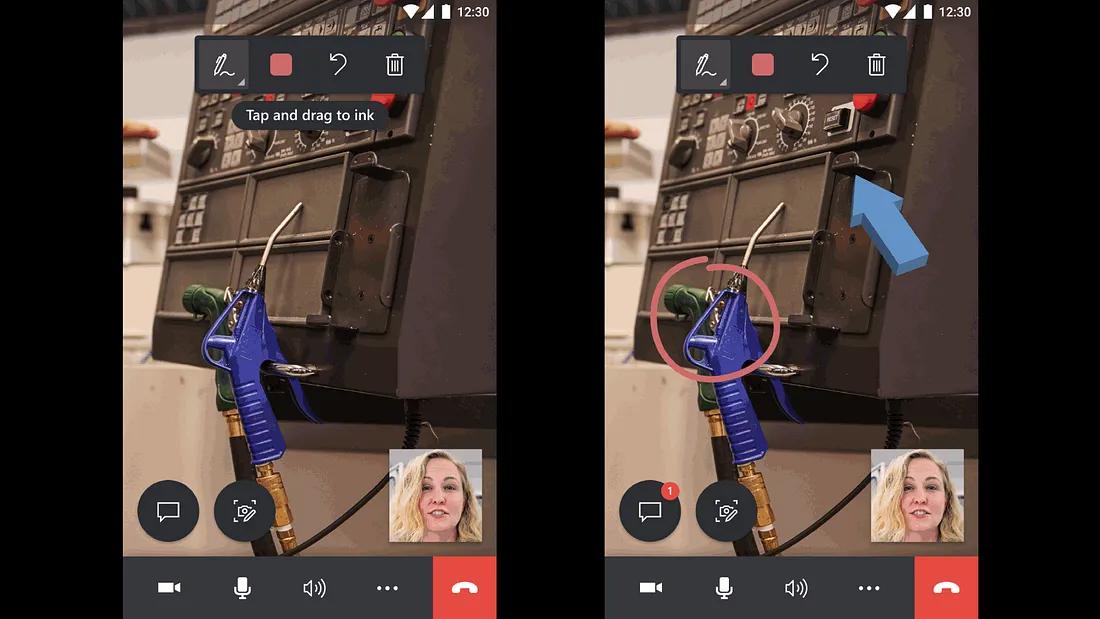
Microsoft offers similar features with their Dynamics 365 Field Service solution. Recently, they’ve leveled this experience up even further with Remote Assist, a companion solution which enables field workers to have an interactive dialog with their head linesperson or maybe even an EHS specialist using Microsoft Teams (this could be from a desktop, tablet, or smart phone). As you can see in Figure 6, Remote Assist supports mixed reality experiences where SMEs can draw freehand sketches over what the linesperson is seeing out in the field. For example, if linesperson discovers a nest on a pole, a remote SME could walk them through options to safely relocate the nest. The conversation is recorded and added to the work order as an attachment and the transcript added to the order timeline.

Figure 6: Working with Dynamics 365 Remote Assist in Microsoft Teams
Another low-hanging fruit option would be to incorporate virtual agents into field service apps. Using low-code solutions like Microsoft’s Power Virtual Agents, we can easily create chatbots which can be embedded in common field service apps, etc. As you can see in Figure 7, graphical tools make it easy to build a script to guide users through common issues (e.g., finding a deceased bird in the field, discovering a nest, and so forth). Besides providing answers to common questions, we can configure these scripts to direct resources to appropriate learning materials, allow them to talk with EHS specialists, or redirect them to other apps/systems (e.g., EHS systems, etc.) to perform follow-on tasks.

Figure 7: Integrating Chatbots into Field Service Apps
Automation & Integration
To round out the user experience, we can use modern workflow and low-code integration tools to automate repetitive tasks, trigger alerts, or replicate data between systems. For example, imagine that a field worker finds a nest while working on a work order task. In this scenario, they fill out an inspection form and move on. Meanwhile, a workflow could run behind the scenes to automatically create an incident in an EHS incident management system in reference to the work order task. Using low-code tools like Power Automate, it’s relatively easy to create workflows like this to smooth out process gaps like this.

Figure 8: Automating Repetitive Data Entry Tasks with Power Automate
Reporting & Analytics
Historically, one of the concerns about building hybrid solutions like this was figuring out how we can trace performance and visualize results. This is another one of those areas where cloud-based business intelligence (BI) tools can simplify matters. For example, with Microsoft Power BI, we could combine data from ERP systems, field service systems, EHS systems, LMS systems, and so forth to create dashboards that can track these processes end-to-end.

Figure 9: Building Reports & Dashboards in Microsoft Power BI
Dynamic Customer Portals
These days, most companies have a page or two within their public website that talks about environmental compliance and biodiversity. However, these pages are usually static in nature. In other words, they contain some information about policies and community involvement, but that’s about it.
Thinking about our avian protection plan, one option for increasing public awareness is to stand up a customer facing EHS portal which provides more interactive access to these kinds of initiatives. Specifically, we can stand up a portal that provides the following types of features:
- Forms to allow customers and/or concerned citizens to report on avian-related issues/observations
- Live updates on cases that were submitted
- Embedded analytics (e.g., like the graphic shown in Figure 8) which provide an up-to-date view of compliance metrics
Not so long ago, such portal experiences would have required a significant amount of custom development. However, with low-code tools like Microsoft’s Power Pages, these sites can be built quickly using easy-to-use graphical editing tools that are similar to popular web tools such as WordPress (see Figure 10). In addition to the site layout features, these types of portal solutions make it easy to securely integrate with backend business systems (e.g., your company field service system).

Figure 10: Building a Self-Service Portal Experience with Power Pages
Closing Thoughts
As we’ve seen throughout the course of this blog post, regulatory compliance is oftentimes a multi-faceted problem that intersects with many different aspects of the business. Whether you’re dealing with avian protection, waste management, or some other complex series of regulations, we hope that this survey of modern technology innovations helps to paint a picture for what future state solutions could look like. As always, we would love to get your feedback and learn more about some of the challenges you’re facing.