



Building the Autonomous Enterprise Without Replacing Your ERP
This article explores how you can use AI agents and intelligent execution layers to automate business processes without waiting for your next major ERP upgrade.

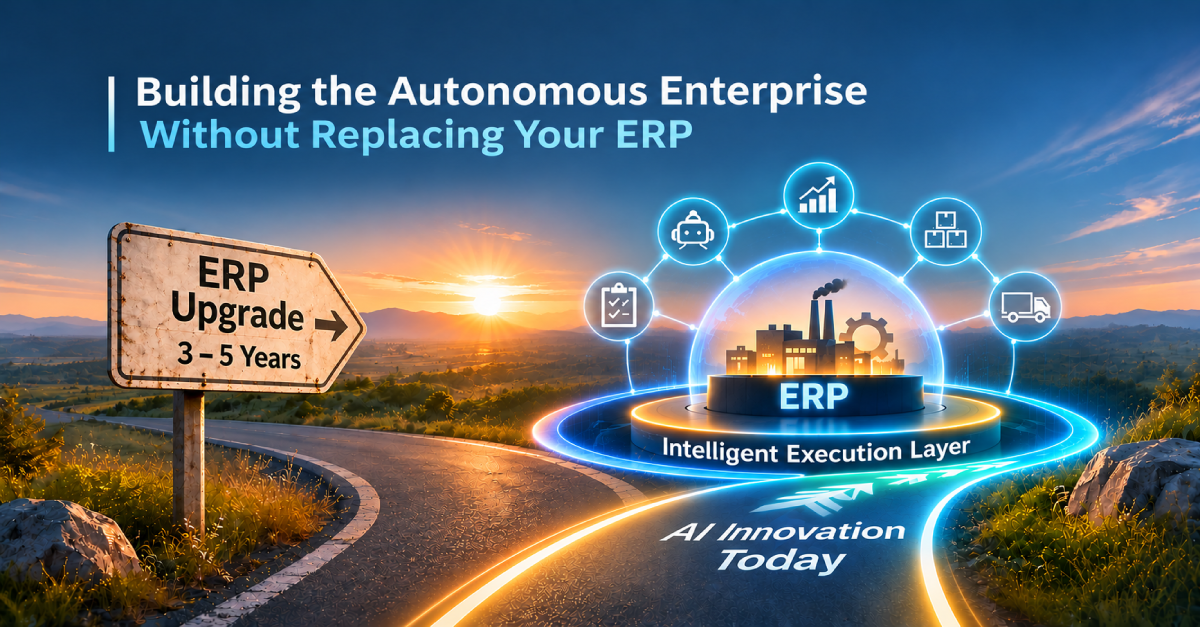
Enterprise Resource Planning (ERP) systems have never been particularly easy to modernize. If you’re like most organizations, these systems represent decades of investment in customizations, integrations, and business processes that have become deeply embedded in day-to-day operations. Replacing or upgrading them can be a costly, multi-year undertaking, often competing with other business priorities for limited budgets and resources.
Meanwhile, AI is advancing at a pace that traditional ERP modernization cycles simply can't match. Business leaders are eager to explore how AI can streamline operations, automate decisions, and make their organizations more responsive. But for companies running older ERP platforms, taking advantage of these capabilities can seem frustratingly out of reach.
The good news is that innovation doesn't necessarily have to wait for the next ERP upgrade. By combining modern integration technologies, enterprise data platforms, and AI agents, organizations can introduce new levels of intelligence and automation around their existing systems while continuing to rely on ERP for the core transactions that run their businesses.
In this article, we'll explore how organizations can begin moving toward autonomous ERP without replacing the systems they already have, why ERP modernization and AI innovation don't have to follow the same timeline, and how an intelligent surrounding architecture can help bridge the gap between today's enterprise systems and tomorrow's vision of Enterprise Resource Execution (ERX).
The ERP Modernization Dilemma
We regularly work with organizations that have substantial investments in ERP systems they know they'll eventually need to modernize. In many cases, these systems are still performing their core functions perfectly well. The challenge is that the surrounding business continues to evolve, and expectations for what enterprise software should be capable of are changing much faster than traditional ERP platforms can keep up.
Consider a company running SAP ECC. Over the years, it's invested in countless enhancements, integrations, and business processes tailored to its operations. The system may be aging, but it continues to do its job. Moving to SAP S/4HANA offers meaningful opportunities for improvement, but the transition also comes with substantial costs, competing priorities, and the potential disruption of processes that employees depend on every day.
Now introduce AI into the equation. Business leaders are seeing demonstrations of an autonomous enterprise where intelligent agents analyze complex situations, make recommendations, and execute business processes autonomously. But taking advantage of these innovations may require a costly ERP upgrade, or waiting another 3–5 years for vendors to deliver on their vision. Either way, the pace of ERP modernization and vendor innovation doesn't always align with the needs of the business. Organizations shouldn't have to put their AI ambitions on hold while waiting for either one.
There's also another practical consideration that often gets overlooked. Many of the business processes organizations want to improve extend well beyond the boundaries of their ERP systems. They involve external applications, operational data, documents, communications, and decisions made by people across the business. Even the most advanced ERP platform isn't going to contain everything needed to automate those processes end to end.
That raises an interesting possibility: What if organizations could begin introducing intelligent capabilities around their existing ERP systems, independently of when they choose to modernize the underlying platform?
Thinking Outside the ERP Box
One of the more interesting developments in enterprise software is that many of the capabilities we're looking to introduce don't necessarily need to reside within the ERP platform itself. While ERP systems remain essential for managing core business transactions, there's no reason all the intelligence surrounding those transactions needs to be embedded in the same application.
In fact, most organizations already operate well beyond the boundaries of their ERP systems. Customer interactions, supply chain activities, field operations, and financial processes frequently span multiple applications, data sources, and business partners. Introducing intelligence at the ERP level alone may improve individual transactions, but it doesn't necessarily address the broader processes connecting them.
This is where the concept of an intelligent surround becomes particularly interesting. Rather than relying exclusively on native ERP capabilities, organizations can introduce intelligence around their existing enterprise systems, allowing them to coordinate activities and make decisions across application boundaries.
There's also a longer-term architectural benefit to this approach. By separating intelligent capabilities from the underlying transactional systems, organizations gain greater flexibility to evolve each independently. An ERP upgrade or replacement doesn't necessarily mean rebuilding every AI-powered process, provided the surrounding architecture is designed with appropriate separation between systems.
Of course, this doesn't eliminate the need for ERP modernization. Aging platforms still introduce challenges around supportability, security, integration, and technical debt. But it does create an opportunity to pursue AI innovation and ERP modernization on parallel timelines, rather than treating one as a prerequisite for the other.
Building an Intelligent Execution Layer
So what does it actually take to make an existing ERP system behave more intelligently? The answer involves bringing together several capabilities that organizations may already have, but connecting them in ways that allow AI agents to participate directly in business processes.
Consider what happens when an AI agent encounters a business exception. Before it can recommend or initiate corrective action, it needs to understand the situation, gather relevant information, evaluate available options, and determine what actions it's authorized to take. Accomplishing this requires more than simply connecting a large language model (LLM) to an ERP system.

Figure 1: Building an Intelligent Execution Layer for ERP
As illustrated in Figure 1, an intelligent execution layer brings together several architectural capabilities:
- Enterprise Context: Provides access to the business information agents need to understand a situation, including transactional data, operational information, documents, and relationships between customers, suppliers, products, and other business entities.
- AI Reasoning: Enables agents to interpret business events, investigate exceptions, evaluate alternatives, and recommend appropriate actions based on available context and defined objectives.
- Process Orchestration: Coordinates activities across applications, using established workflows and deterministic business rules to manage how decisions are translated into actions.
- Integration and Connectivity: Provides secure, controlled access to ERP transactions and other enterprise systems through APIs, events, and integration services.
- Governance and Oversight: Establishes the permissions, approvals, monitoring, and audit trails needed to ensure agents operate within defined boundaries.
The good news is that implementing this architecture doesn't necessarily require an entirely new technology stack. For example, we've built these foundations for customers invested in the Microsoft ecosystem using technologies such as Azure Integration Services, Microsoft Fabric, Dataverse, Copilot Studio, and Azure AI. Similar approaches can be implemented using other cloud platforms and enterprise technologies.
From Reasoning to Execution
These capabilities work together to bridge the gap between understanding what's happening in the business and taking action. An agent might recognize an exception, retrieve information from several systems, evaluate possible responses, and initiate a workflow that updates an ERP transaction or requests human approval.
An important distinction is that AI reasoning and transactional execution serve different purposes. Agents are well suited to interpreting ambiguous situations, evaluating alternatives, and coordinating activities that traditionally require human judgment. Deterministic workflows and ERP applications remain responsible for enforcing critical business rules, validating transactions, and maintaining data integrity.
More Than Just Agents
Bear in mind that we’re talking about much more than just a tapestry of AI agents. While these agents carry a lot of responsibility within the intelligent execution layer, they shouldn't be responsible for everything. Reasoning through an unexpected business situation is fundamentally different from calculating sales tax, enforcing credit limits, or posting a financial transaction. Those operations still benefit from deterministic logic and the transactional controls already built into enterprise systems.
The real opportunity comes from combining these capabilities. AI can introduce flexibility and judgment into processes that previously required human intervention, while established integration services, workflow engines, and ERP applications continue handling the predictable, rules-driven aspects of execution.
With this architecture in place, you can start introducing intelligent capabilities around your existing ERP environments without waiting for the next major platform upgrade.
What Autonomous Execution Looks Like in Practice
To understand what this architecture makes possible, consider a common challenge in manufacturing: a supplier shipment is delayed, putting an upcoming production order at risk.
In a traditional ERP environment, the delay might trigger an exception report, notification, or workflow, provided the supplier communicates the delay through something like an Advance Shipping Notice (ASN) that the ERP system can recognize and process. From there, someone in procurement or production planning typically needs to investigate the problem. They'll check inventory levels, review alternative suppliers, evaluate production schedules, and determine whether customer commitments will be affected. Depending on the situation, resolving the issue could involve several people working across multiple applications, spreadsheets, emails, and phone calls.
Now imagine that same scenario with an intelligent execution layer operating alongside the ERP system.
Rather than relying exclusively on structured transactions like an ASN, AI agents can interpret less structured communications, such as emails, text messages, or other supplier notifications, to identify potential disruptions. Once a delay is identified, an agent could begin investigating its impact without waiting for someone to work through an exception queue. By gathering information from ERP transactions, inventory systems, production schedules, and supplier communications, the agent could determine which orders are affected and evaluate possible alternatives.

Figure 2: Adding Intelligence to Workflow Processes
Perhaps another facility has sufficient inventory to cover the shortage, or an alternate supplier can deliver the required materials in time. The agent could compare these options against business priorities, costs, and delivery commitments before recommending a course of action.
Depending on the level of autonomy the organization is comfortable granting, the agent might then initiate an inventory transfer, prepare a revised purchase order, or request approval from a procurement manager before proceeding. Once an action is authorized, established workflows and ERP interfaces handle the actual transactions, applying the same business rules and controls that govern other enterprise processes.
The difference is that much of the investigation, analysis, and coordination that previously required manual effort can now happen automatically. Employees can focus their attention on exceptions that genuinely require judgment rather than spending their time gathering information and moving it between systems.
Similar opportunities exist in financial operations, customer service, field service, and other business processes where resolving an issue requires information and actions spanning multiple systems. And because the intelligence resides outside the ERP platform, organizations can introduce these capabilities without waiting for their next major ERP upgrade.
Modernizing at Your Own Pace
One of the biggest advantages of introducing an intelligent execution layer is that it allows you to pursue AI innovation and ERP modernization on separate, but complementary, timelines. You can begin introducing new capabilities around your existing systems today while continuing to plan for their eventual upgrade or replacement.
Of course, this doesn't mean you can ignore the limitations of aging ERP platforms. Older systems still present challenges around security, supportability, integration, and technical debt. In some cases, those limitations may need to be addressed before introducing more sophisticated automation. The key is recognizing that modernizing your ERP platform and modernizing the business processes surrounding it don't necessarily have to happen at the same time.
There's also an opportunity to make investments that serve both objectives. Exposing ERP functionality through well-designed APIs, adopting event-driven integration patterns, improving access to enterprise data, and separating business logic from tightly coupled customizations can all support intelligent automation today while laying the groundwork for a future ERP transformation.
That last point is particularly important. An intelligent execution layer shouldn't become another collection of custom integrations and automation scripts that are difficult to maintain or replace. By establishing clear boundaries between AI reasoning, process orchestration, and transactional execution, you can reduce dependencies on any particular ERP platform and preserve more of your investment when the underlying systems eventually change.
We also wouldn't recommend trying to make every business process autonomous overnight. A more practical approach is to identify a process where better access to information, faster decision-making, or reduced manual coordination could deliver measurable value. Start by allowing agents to investigate exceptions and recommend actions, then gradually introduce greater autonomy as you gain confidence in the technology and the controls surrounding it.
Over time, these incremental improvements can become part of your broader modernization strategy. When you're ready to upgrade or replace your ERP platform, the integration services, enterprise context, and intelligent workflows you've already developed can continue to provide value, even as the underlying transactional systems evolve.
Closing Thoughts
If your next ERP upgrade is still three to five years away, that's a long time to put meaningful business improvements on hold. Especially when many of the technologies needed to introduce intelligent automation are already available and can work alongside the systems you're running today.
As we've explored, introducing intelligence around your existing enterprise systems allows you to take advantage of AI-powered automation without disrupting the transactional foundation your business depends on. Better still, many of the investments you make along the way can help prepare you for your eventual ERP modernization.
ERP vendors will continue introducing more sophisticated AI capabilities, and those innovations will influence how enterprise applications evolve. But there's no reason your innovation roadmap needs to be dictated entirely by your vendor's release schedule.
The question isn't necessarily when you'll be ready to modernize your ERP. It's what you could be doing with AI in the meantime.